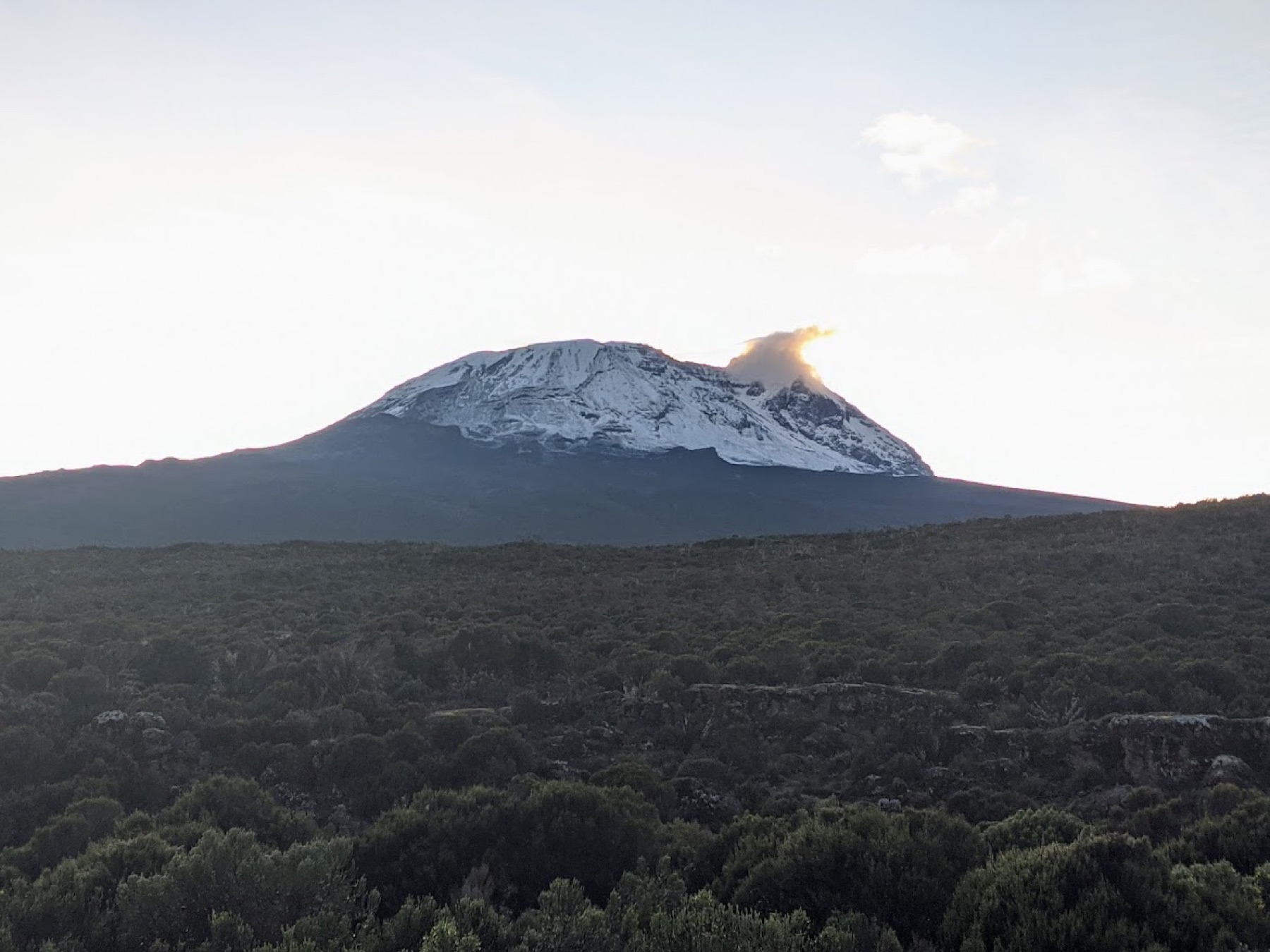
Trekkers ascending the dramatic Barranco Wall on the Machame Route
Challenging

Machame Route · The Whiskey Route

The "Whiskey Route" — the most scenic path on the mountain. Stunning views through moorland and alpine desert.

Duration
6–7 Days
Distance
40 km / 25 mi (ascent)
Approach
Southern Circuit
Difficulty
Challenging
From
$2,400 pp

Route overview

Longer and more demanding than either Marangu or Rongai, the Machame Route has earned its place as one of Kilimanjaro's most sought-after ascents — and for good reason. This journey is a masterclass in the mountain's extraordinary range of ecosystems: dense, dripping cloud forests give way to open moorland, before the terrain hardens into the glaciated precipices of Kibo's formidable south face. The descent follows the Mweka Route — a steep, dramatic passage through arid mountain desert and verdant lowland forest that offers a fittingly grand finale. Its "Whiskey Route" nickname says it all: smooth going down, but you'll feel it.

  • The mountain's most scenic and varied route
  • The legendary Barranco Wall scramble
  • Superb "climb high, sleep low" acclimatization
  • Nights under some of the clearest skies in Africa

Itinerary — day by day

Day 1

Machame Gate to Machame Camp — Into the Jungle

Your Kilimanjaro story begins with a 30–45 minute drive through Machame village, then straight into thick rainforest. The trail winds upward along a ridge, often muddy and slick at lower elevations (gaiters and poles earn their keep here), before delivering you to Machame Camp — base one of seven, and already a world away from everyday life.

Elevation
1,830 m → 3,050 m (6,000 → 9,950 ft)
Distance
11 km / 7 mi
Hiking time
5–6 hours
Habitat
Montane Forest
Meals
Lunch, Dinner
Overnight
Machame Camp
Day 2

Machame Camp to Shira Camp — Above the Clouds

The rainforest fades behind you as the trail climbs a steep, rocky ridge, then cuts west through a dramatic gorge. By the time you reach Shira Camp, you're standing on the edge of an ancient volcanic plateau — and the views start getting serious.

Elevation
3,050 m → 3,850 m (9,950 → 12,600 ft)
Distance
5 km / 3 mi
Hiking time
4–5 hours
Habitat
Moorland
Meals
Breakfast, Lunch, Dinner
Overnight
Shira Camp
Day 3

Shira to Lava Tower to Barranco Camp — The Shark's Tooth

Today delivers one of Kilimanjaro's most iconic landmarks: the Lava Tower, nicknamed the "Shark's Tooth" (4,650 m / 15,250 ft). You'll climb high to reach it, then descend to Barranco Camp — ending the day at nearly the same altitude you started. This "climb high, sleep low" strategy is secretly one of the most important acclimatization tricks on the whole mountain.

Elevation
3,850 m → 4,000 m (12,600 → 13,000 ft), via Lava Tower 4,650 m
Distance
10 km / 6 mi
Hiking time
5–6 hours
Habitat
Semi-desert
Meals
Breakfast, Lunch, Dinner
Overnight
Barranco Camp
Day 4

Barranco Camp to Karanga Camp — Conquer the Wall

Today's headline act: the legendary Barranco Wall. Part scramble, part climb, all adrenaline — this is the moment trekkers talk about for years afterward. Once you're up, the trail eases into the Karanga Valley, linking up with the Mweka Trail junction.

Elevation
4,000 m → 4,050 m (13,000 → 13,250 ft)
Distance
5 km / 3 mi
Hiking time
3–4 hours
Habitat
Alpine Desert
Meals
Breakfast, Lunch, Dinner
Overnight
Karanga Camp
Day 5

Karanga Camp to Barafu Camp — Base Camp for the Summit

A short day, but a strategic one. You'll complete the South Circuit, taking in fresh summit angles before settling into Barafu — basecamp for tomorrow's biggest test. Eat well, rest hard, and let the anticipation build.

Elevation
4,050 m → 4,700 m (13,250 → 15,350 ft)
Distance
4 km / 2 mi
Hiking time
3–4 hours
Habitat
Alpine Desert
Meals
Breakfast, Lunch, Dinner
Overnight
Barafu Camp
Day 6

Summit Day — Barafu to Uhuru Peak, down to Mweka Camp

Midnight. Headlamps on. This is it. You'll climb between the Rebmann and Ratzel glaciers, pushing through heavy scree toward Stella Point as the sky slowly lightens — and the sunrise that greets you there is one you'll remember for the rest of your life. From Stella Point, the final stretch to Uhuru Peak awaits, often dusted in snow. Standing at 5,895 m, the highest point in Africa, is a feeling no description can capture. Then comes the long descent to Mweka Camp, with a well-earned lunch stop at Barafu along the way.

Elevation
4,700 m → 5,895 m (15,350 → 19,340 ft), down to 3,090 m
Distance
5 km up / 13 km down
Hiking time
5–7 h up / 5–6 h down
Habitat
Stone scree & ice-capped summit
Meals
Breakfast, Lunch, Dinner
Overnight
Mweka Camp
Day 7

Mweka Camp to Mweka Gate — Victory Lap

The final stretch — and it's all downhill from here, literally. Descend to Mweka Park Gate, where your summit certificate makes it official. The lower trail can be wet and muddy, so keep those gaiters handy. From the gate, it's on to Mweka Village for your ride back to Moshi. Tip your guides, hug your porters, and start planning how you're going to tell this story.

Elevation
3,090 m → 1,680 m (10,150 → 5,500 ft)
Distance
10 km / 6 mi
Hiking time
3–4 hours
Habitat
Forest
Meals
Breakfast
Overnight
Return to Moshi

Pricing

From $2,400 per person, with group discounts as your party grows. Contact us for a tailored quote for your group size and dates.

What's included

  • All Kilimanjaro National Park entry, camping & rescue fees (KINAPA)
  • Professional KINAPA-certified mountain guides
  • Full support crew — cooks and porters
  • All meals on the mountain, freshly prepared
  • Quality four-season tents and sleeping mattresses
  • Pulse-oximeter monitoring and emergency oxygen
  • Airport transfers and trailhead transport
  • International flights and Tanzania visa
  • Travel and medical insurance (mandatory)
  • Tips for guides, cooks and porters
  • Personal trekking gear and clothing
  • Drinks, snacks and personal items

Good to know

How fit do I need to be for the Machame Route?

You don't need to be an athlete, but Kilimanjaro is a serious high-altitude trek. A few months of regular cardio plus some long day-hikes with a pack will serve you well. On the mountain the golden rule is "pole pole" — slowly, slowly.

What about altitude and acclimatization?

We build in "climb high, sleep low" days, monitor oxygen saturation twice daily with pulse oximeters, and carry emergency oxygen. Longer itineraries dramatically improve how comfortably you summit.

When is the best time to climb?

The dry seasons — January to mid-March and June to October — offer the most reliable conditions. We run treks year-round and are happy to advise on the best window for your dates.